Showing posts with label Famous Promenade addresses. Show all posts

December 6, 2009

Park Phoenix - 405 Promenade des Anglais


Apart from the park's amazing size, over 7 hectares of land, the reknown of Parc Floral Phoenix is its immense greenhouse, one of the largest in Europe and known as the Green Diamond. This amazing glass and metal tent-like structure, 22 meters / 72-foot high and extending over 7,000m², houses the most complete range of plants ever assembled in Europe and offers the visitor 7 different tropical and sub-tropical climates. Designed by architects Selme and Tampon-Lajariette, it was built in 1989 and opened in February 1990.


The entrance to Parc Phoenix is located west of Nice at the Promenade's end on number 405 (the last number being 461), a stone's throw from the airport and within the Arénas district, Nice's bustling business quarters adorned by tall mirror-façade buildings complete with hotels, restaurants, and shops. It is now the most visited botanical garden on the Côte d'Azur, with Monaco's Jardin Exotique in second place and Eze's Jardin Exotique a close third.


When you start your visit, you'll find yourself directly in front of the park's central feature: an enormous 6,000m² lake. Interestingly, the Museum of Asian Arts (free admission, closed on Tuesday), with its 'white hat' in the picture above, is built on this same lake and adds a somewhat oriental feel to the start of your tour.


Open: daily, April to September - 09:00 to 20:00; October to March - 09:00 to 17:00
Admission: 2 euros; children under 12 free

November 8, 2009

Villas on the Promenade. Number 13-15: Palais de la Méditerranée


From this palace, built in 1927, only the façade and entrance have been preserved. It was designed as a prestigious casino hotel by the Charles Dalmas, who had already designed several grand hotels in Nice, after an original idea by J. Aletti, a famous French hotel owner. The project was financed by the American billionaire Frank-Jay Gould, who had launched the nearby seaside resort of Juan-les-Pins and was owner of a string of casinos and hotels on the French Riviera. Its Art Deco façade, made from beige Lens limestone, has some truly magnificent bas-reliefs sculptures by Antoine Sartorio.

Under Dalmas's careful eye and direction, it was constructed in one year with the assistance of 350 workers and inaugurated on 10 January 1929 after some difficulties in obtaining a gambling licence, and was a beautiful example of Art Deco. A 1,000-seat theatre made up of stalls surrounded by baignoires, with boxes and loges above, and yet another level forming a balcony, attracted the greatest names in the world of Arts and Entertainment, among them Maurice Chevalier, Jules Romain, Edith Piaf and Josephine Baker.


After the glitz and glamour of the 1930s, the grandeur of the Palais gradually declined, especially after it had been ravaged by fire in 1934. Gould then decided to rent it to a development company, Société Fermière du Palais de la Méditerranée who managed it until it finally closed its doors in April 1978 due to financial difficulties. Vandalized, the building was demolished in May 1990 by mechanical shovels that left a gaping hole. Its two façades became a listed monument in extremis in August 1989.

It reopened in January 2004, following a multi-million Euro restoration overseen by Concorde Hotels & Resorts. Now there is at the ground floor a casino and a 4 star hotel that looks out onto a large indoor swimming pool at the sea-side. At the back of this complex they built the following apartment buildings: 'Le Baccara', 'Le Belle-Epoque', 'Le Riviera', and 'Le Palace' who look out onto a private garden and find their entrance at the Rue de France, parallel to the Promenade.

If you like to read more about the Palais de la Méditerrnanée, I can recommend you the book 'La Promenade des Anglais, History and reminiscences', which can be purchased for only a few euros in the museum shop of the Massena Museum. Then you can read also about the unsolved mystery around the Palais.

May 9, 2009

Villas on the Promenade. Number 113: the Palais de l'Agriculture


Inauguration of the renovated Palais de l'Agriculture

The Palais de l'Agriculture is the location for the headquarters of the 'Société d'Agriculture, d'Horticulture et d'Acclimatation de Nice et des Alpes-Maritimes' (S.C.A.H.). (Click on the picture to enlarge.)

The villa is built on the Promenade between its angle with the Boulevard de la Madeleine and Avenue de Bellet. These streets are in fact one broad Boulevard with the Palais de l'Agriculture in between which were built to cover the river 'Vallon de Magnan'.
This building, designed by Paul Martin, an engineer and General Secretary of the Society, was built in 1900 and shows the distinct neo-classical style so prevalent at the time. This yellow ochre building, decorated with pedimental windows, ornamental mouldings and friezes, consists of a central fronton flanked by two smaller wings. A wide marble staircase leads up to the main entrance.


The Palais de l’Agriculture was inaugurated on 8 April 1901 by Emile François Loubet, the French President. And thus the building has remained, surviving two world wars and escaping demolition or modernisation.

But now the façade is very recently completely restored in all its glamour and newly inaugurated by the mayor of Nice, Mr Christian Estrosi on the 6th of April 2009. See above the crowd that was present on the Promenade.


The Society was created in 1860 and counted amongst its members and benefactors the
Grande Duchesse Hélène of Russia, the Prince of Monaco, Charles III, Baron de Rothschild and the Mayor of Nice. Its primary aim was the study of plants and animals brought back from various expeditions around the world. By the 1920s their research had inspired many horticulturists to increase and diversify their production, thus ranking Nice second in the world for the production of cut flowers.


The Society continues to be very active today with outings, conferences and garden visits, as well as offering advice on the many different aspects of gardening on the French Riviera. See the website of S.C.A.H on www.scah-nice.fr

February 2, 2009

Villas on the Promenade. Number 65: Villa Guiglia


The villa was designed by the notable Niçois architect, Roger Séassal, and was once the residence of Charles Frédérik Spang, a rather rich industrialist in the steel business, who sold his business to the Carnegie Empire and then retired to Nice. It was later the property of Vincent Guiglia (1789-1878)(brother of Count Louis Guiglia, president of the senate of Nice) who gave it its name and also bequeathed it to the city of Nice.


Much like the stunning Palais de la Méditerranée, only the façade and entrance have been preserved. The municipality first used the building as a training college for the hotel trade until it became the C.U.M: Centre Universitaire Méditerranéen in December 1933, when Paul Valéry was appointed its Director. It is designed as an intellectual centre.
In that time they built one of the most beautiful amphitheatres of France inside the building. Also classical concerts and many conferences are given here, which are mostly free to visit, which attract more than 80.000 visitors each year. See more about this white - light rose villa on the website.

Later Jean Médecin also took care of the creation of the university of Nice which was founded on 1965, the year of his death, see more information here.
Jean Médecin (1890-1965) was Mayor of Nice from 1928 to 1943 and from 1947 to 1965, and the father of Jacques Médecin, whom succeeded him as mayor until 1990. Nowadays the University has 8 faculties, located in several beautiful ancient buildings and is attached to Sophia Antipolis, that is a large technology park in the inland of Nice (in Valbonne), which you can consider as the Silicon Valley of Europe.

January 29, 2009

Villas on the Promenade. Number 139: Villa Collin-Huovila


Out of hundreds of villas that once existed on the Promenade des Anglais, this is one of the survivors, now being squashed between apartment blocks. It is located on number 139, near the Lenval hospital on the Promenade.

Plans for this amazing (exaggerated !) Art Nouveau building with its curved façade, polychrome ceramic decorations and impressive red roof shaped like a Samourai's hat, were drawn up by Marius Allinge in 1907 for Carl Constantin Collin (1863-1941), an eccentric Finnish millionaire. The villa has changed owners, but is still in private hands.

The corner carytid sculpture, created by François Louis Virieux, is a delightful scene showing a young lady playfully trying to avoid a shower of roses from two cherubs.


I made this picture last year. It is a pity that they made windows and did not keep the little glasses as you see in the first picture. However the contrast couldn't be bigger with this adjacent villa in art deco style. It is amazing how the style changes only a few years later.

This picture can be found on http://www.huovila.net/gallery/Fgallery2-2.jpg
The original detached house once upon a time ...(today it is on the left attached to an apartment house).

January 27, 2009

Villas on the Promenade. Number 61: Villa Furtado - Heine


This villa (number 61 on the Promenade) was built for Lady Penelope Rivers in 1787. However, 1789 is the year of the French Revolution and Lady Rivers fled back to England abandoning the villa. It became public property and was sold to Sébastien Grandis who rented the villa out to wealthy winter residents such as Pauline Borhèse, Napoleon’s sister, and Marie-Louise de Bourbon-Parme. After many other owners is was bought in 1883 by Cécile Charlotte Furtado-Heine. She let her villa transformate into a retirement home for sick and injured officers. It has remained so ever since, today officers are taking holiday here and so it is referred to as the “Villa des Officiers”.


Please don't enter this gate as the garden is private domain! I did it once, I did not know then, I was taking pictures like a tourist, the gate was open and looked like the gate of the Massena museum which has a public garden, then suddenly the gate closed automatically and I was captured. There are cameras in the garden that will catch you. The old officers liked to capture me and once in the building they told me to call the police. One friendly officer let me escape at the back door which is located at 121, Rue de France.

In a side street of the Promenade next to the villa, the Rue Honoré Sauvan, you can find the Four Points Sheraton Elysee Hotel. It is outlined by 2 monumental bronze sculptures of Venus by a Nice artist, Sacha Sosno. It looks like if Venus is between the construction of the building, which is very special.

January 26, 2009

The Massena Museum on the Prom


Next to the Negresco hotel on the Promenade des Anglais you can find the Massena Museum. Like all municipal museums in Nice, the admission is free.

The Massena Museum reopened in March 2008 after a big renovation (started in 1999) of the building and the gardens. Built from 1898 to 1901, Victor Massena, the great-grandson of Marshal André Masséna (1758-1817), gave it to Nice in 1917. It was then transformed into a regional history museum. On the ground floor you can visit the villa as it was decorated with empirical items, including some from the Napoleonic times.

The two floors above trace the history of Nice in chronological order. You can see how the fisherman lived in the houses on what is now the Quai des Etats-Unis, the several political powers that ruled over Nice (till 1860 it belonged to Savoye). Further you can learn something about the construction of the Promenade des Anglais, and the European aristocracy that discovered Nice. A large painting of Queen Victoria is exhibited. There is too much to list. I can assure you, it is worth a visit.

January 21, 2009

The Negresco Hotel


The hotel was built by the Romanian Henri Negrescu and designed by the Dutchman Edouard Niemans and it was Eiffel who designed the steel construction for the glass dome of the Salon Royal in the centre of the building. Here you can watch the chandelier composed of 16,309 Baccarat crystals, originally commissioned by the last Czar of Russia. Exactly the same chandelier is in the Kremlin in Moscow.
The hotel opened in 1913 but was turned into a hospital during the first world war and then fell into the hands of creditors after the war.


In 1957 the hotel was bought by the Augier family. Mrs Jeanne Augier personally decorated all rooms with the most expensive antiques and arts, so staying at Negresco is like living in a museum. Mrs Augier still lives in the Negresco, in the whole upper floor of the building, the pink dome at the corner included.


There are only three portraits in the world of Louis XIV: one in the Louvre museum, Paris, one in Versailles and one in the Negresco hotel. If you are rich and famous, you definitely stayed in the Negresco hotel one time.

Just like the view from the 5 star Negresco Hotel.... but a quarter the price!

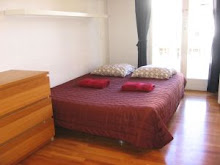
Nice Promenade Holiday Apartments
3 bedroom holiday apartment to rent on the Promenade des Anglais.